



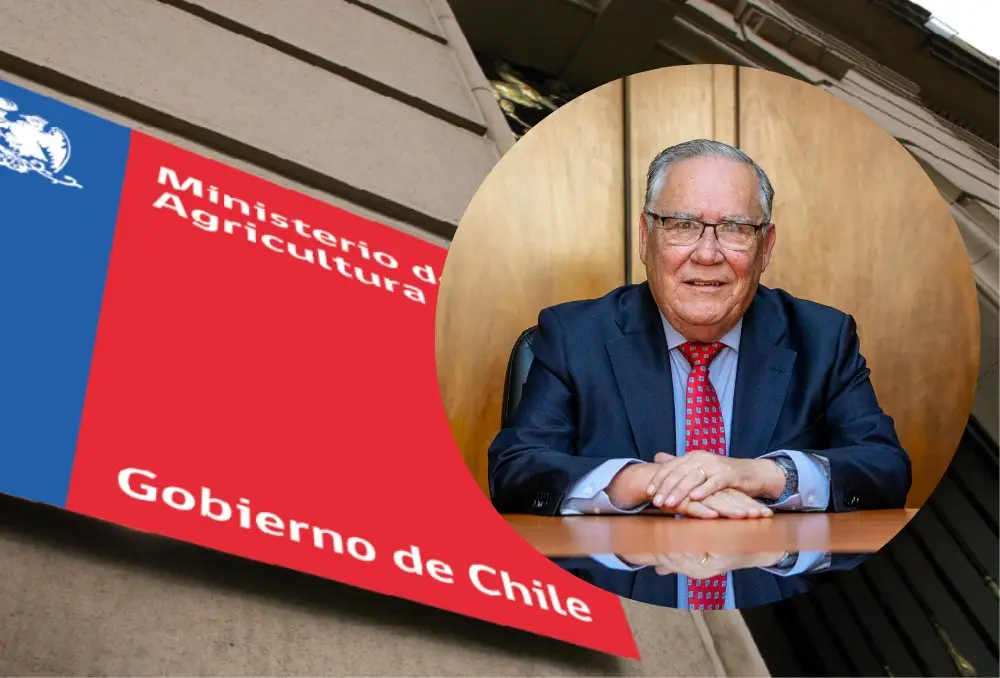
Jaime Campos, the newly appointed Minister of Agriculture, discusses the challenges and opportunities for the meat sector as part of Chile’s export strategy. He highlights the importance of animal health, opening new markets, and updating trade agreements, while emphasizing the need to strengthen public-private coordination and protect Chile’s health reputation. He also examines growth prospects for pork and poultry exports, the potential of emerging markets in Asia, and the challenges around land-use planning and regulations.
Based on your experience in the agri-food sector, what role will food exports, especially pork and poultry, play in Chile’s strategy? What specific goals have you set?
Twenty-five years ago, it was unthinkable for our country to become an exporter of pork, poultry, beef, or lamb. However, thanks to the agro-export model, today we have a vibrant meat industry that not only meets domestic needs but also reaches the world’s biggest markets with its products.
The volume and resources involved are already significant compared to the country’s export offer. This is a result of the free trade agreements Chile has signed, and especially the plant and animal health agreements we continue to sign with our main destination markets. Naturally, we will maintain this policy and development strategy, as we believe there is still room for growth.
Of course, the administration doesn’t set any numbers because it doesn’t produce anything; that’s for the industry to decide. That’s why working closely with the industry and the private sector in general is so important, and that’s what we’re committed to doing.
Chile has earned a strong international reputation for safety. What steps will be taken to maintain this reputation and the trust of global markets, especially given threats such as exotic diseases?
There is no doubt that one of Chile’s strengths or competitive advantages in international markets is its high standards for plant and animal health. We are practically free of most diseases and epidemics that, unfortunately, continue to devastate many countries that produce poultry, pork, or beef. Our responsibility as the Ministry of Agriculture, through the Agricultural and Livestock Service (SAG), is to protect that strength.
Chile has not only experience in eradicating diseases but also in controlling them when unfortunate episodes occur. In animal health issues, there’s no such thing as zero risk. Chile has been developing protocols for responding when an episode occurs.
These protocols, established in partnership with the private sector, are validated and recognized by our trading partners and health agencies in destination markets. Our duty and commitment are to comply fully, even if that could cause negative impacts in the short term. In my view, preserving Chile’s reputation in this regard is a higher imperative, which is why we put so much effort into it.
Expanding into new markets is crucial for the food industry’s growth, especially for meat. What should be the top priorities to speed up health authorizations and trade agreements with new destinations?
I’m quite pleased with Chile’s current agro-export development model, as I said earlier. However, I would like to add two comments.
Most of Chile’s current trade agreements were signed over 20 years ago. The same applies to the plant and animal health protocols or agreements negotiated at that time. But the world continues to change at an astonishing pace.
20 years is more than enough time to review our current situation and see how we can adapt those agreements to today’s global and domestic trade realities. The other point is that, even though we’re proud of what we’ve achieved and opportunities for exporting still exist, we must not forget—I certainly can’t—that there are still hundreds of millions of consumers in some parts of the world that we haven’t reached. I’m thinking about India, Indonesia, and some Southeast Asian countries.
If you ask me about new destinations we should consider, I will naturally mention those, but that doesn’t mean we shouldn’t keep focusing on access to interesting markets such as Japan, China, the United States, the European Union, and others.
You talked about the importance of strengthening public-private collaboration. What mechanisms will be put in place to work closely with trade associations like ChileCarne on key issues such as biosecurity, market access, and sustainability?
In one word: it’s essential. If there is no agreement between the public and private sectors on these issues, we won’t make much progress. It is a necessary condition for the sector’s development. And the reason is quite simple: the State, the government, produces nothing.
Sure, we can establish rules and incentives; we can set the conditions for businesses to grow. But if no private party is willing to put them into practice and seize the opportunities we’re opening, the impact will be non-existent. That is why I hope and trust—and that’s the spirit I’ve seen in every leader from Chile’s forestry and agricultural sector—that we will continue working very well together.
Of course, we will continue the strategy of maximum collaboration, as it has proven successful.
One critical challenge for the meat industry is land use planning and legal certainty. As regulatory and environmental demands grow, how can we prevent them from hindering the competitiveness of the export sector?
I think your question addresses two issues that, although related, are not closely linked, so we need to discuss them separately.
First, as directed by the President, the ministry is conducting a thorough review of its regulatory powers to see how we can modify, adapt, and simplify existing regulations to support the sector. In short, we are working to make the permitting process more efficient.
Secondly, land use planning still poses a challenge for our country, and the Ministry of Agriculture is just one of many parties involved. To address the issue, we need the involvement of other relevant parties, such as the ministries of Public Works, Housing, Social Development, and Education. As an administration, we must improve our coordination, understanding that we represent different interests, but also that we are competing for the same resource: land. If you ask any Minister of Agriculture, they will tell you that one of their main goals is to preserve as much agricultural land as possible, simply because land is a scarce and limited resource that needs to be used rationally. However, this should not prevent other economic activities, such as manufacturing, from having their own space. Therefore, finding a fair balance between the two is one of the key challenges of governing.