


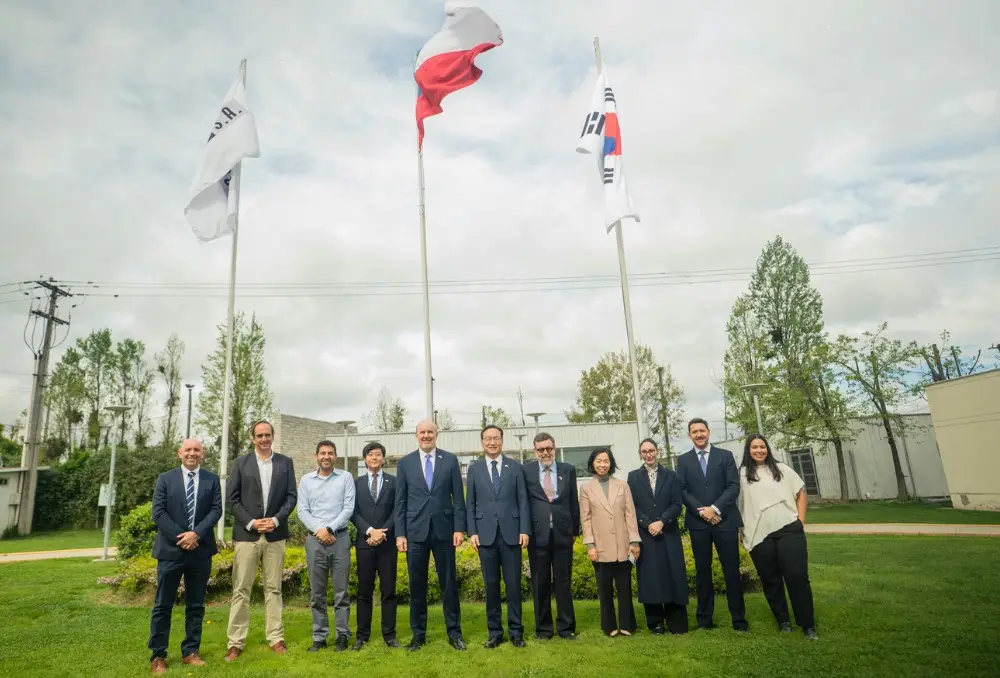
Hak-Jae Kim, Ambassador of the Republic of Korea to Chile, alongside members of the diplomatic corps and executives from Coexca, during his visit to the company’s headquarters and main processing plant. The visit showcased the company’s production model and food safety and quality standards, and highlighted the commercial and institutional ties with South Korea, Coexca’s top export market.
Hak-Jae Kim, the Ambassador of the Republic of Korea to Chile, learned about Coexca’s production model, quality and safety standards, and development projects during a visit to the company’s headquarters and main processing plant. He toured the facilities and gained insight into the stages involved in producing pork for some of the world’s most demanding markets.
The visit was particularly significant given Coexca’s ties to South Korea, which is currently its primary export market and receives nearly one-third of the company’s shipments.
The ambassador was accompanied by members of the diplomatic mission and by Mark Thiermann, president of the Chilean-Korean Chamber of Commerce. They were received by Guillermo García, CEO of Coexca; the company’s senior executives; and Juan Carlos Domínguez, president of the Chilean Meat Exporters Association (ChileCarne).
During the tour, Ambassador Kim learned about the stages of pork processing and Coexca’s vertically integrated production model, which spans pig farming, animal feed manufacturing, and the processing and marketing of products. Mr. Kim also learned about the food safety and quality measures implemented to meet international market requirements, including those in South Korea.
The ambassador praised the high standards observed during the visit and commended the company’s production achievements, as well as the processes it has implemented to develop products for highly demanding markets.
Mr. García thanked the delegation for visiting and highlighted the relationship built over the years with South Korea. “Korea has been a very important market for Coexca for many years. We have built a relationship based on trust and friendship, and we continue our efforts to meet their high standards and the needs of our customers,” said the CEO.
In the afternoon, the schedule continued at the University of Talca’s Lircay Campus, where Hak-Jae Kim delivered a lecture titled “Building bridges: Economy, culture, and opportunities between Korea and Chile,” organized jointly by Coexca and the university.
Before an audience of nearly a hundred students, academics, executives from Coexca, and special guests gathered in the Bicentennial Auditorium, the diplomat looked back on the relationship between the two countries over the past 60 years and noted that Chile was the first country with which Korea signed a free trade agreement.
“Over the past two decades, the FTA has helped connect our markets. Today, we are broadening our cooperation to include investment, supply chains, technology, and innovation,” he said.
The ambassador noted that new challenges present opportunities to strengthen the relationship between the two countries by leveraging their complementary skills, particularly in digital transformation, artificial intelligence, the energy transition, and secure supply chains.
“If Korea and Chile combine their strengths, we can move beyond a trade relationship and become partners capable of creating new technologies, industries, and ideas together,” he said. He summed up the challenge in one sentence: “Trade connects markets; innovation creates opportunities.”
During his remarks, Hak-Jae Kim also highlighted Coexca as an example of innovation and compliance with high-quality standards, which have enabled the company to consolidate its presence in the Korean market.
The University of Talca’s president, Arcadio Cerda, thanked the diplomat for his visit and praised the opportunity for the university community to hear the diplomat’s firsthand vision for the future of Chile-South Korea relations. Cerda also thanked Coexca for its collaboration, which made the meeting possible and introduced the academic community to the opportunities presented by a growing bilateral relationship.