


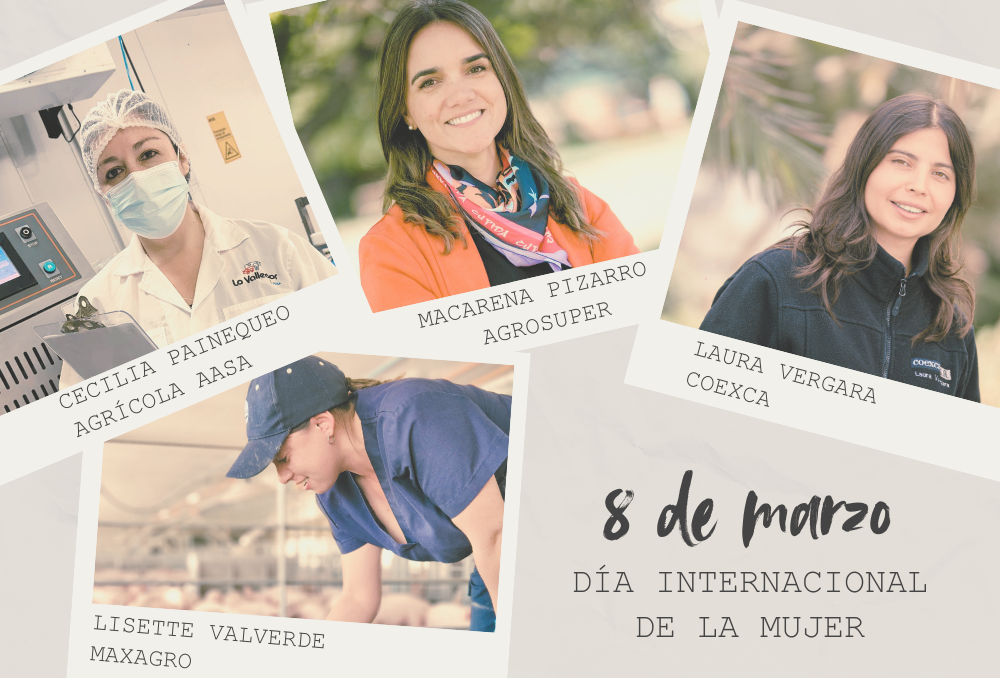
On International Women’s Day, March 8, the pork and poultry production and export sector celebrates a transformation that can now be seen throughout the entire supply chain: an increasing number of women in production, technical, and strategic roles, where they contribute rigor, commitment, and a comprehensive perspective that strengthens the industry’s competitiveness and sustainability.
From breeding farms and production units to quality management, innovation, and commercial strategy, female talent has made its way into leading companies, including ChileCarne partners like Agrícola AASA, Coexca, Maxagro, and Agrosuper. This development is not just cultural: it has concrete effects on operational efficiency, standards compliance, and business results.
Output and quality: Impact on day-to-day operations
As the head of breeding at Agrícola Chillán Viejo (Maxagro), Lisette Valverde has been at the heart of this transformation. She started in the statistics department, strengthening her analytical and decision-making skills, and today she leads a team in the field.
“It has meant profound professional and personal growth. Working in production has taught me that leadership isn’t just about making decisions, but also about supporting, building trust, and raising awareness within teams. Every challenge has been a learning opportunity,” she says.
In her experience, diversity has a direct impact on day-to-day management. “Teams are more collaborative, and decision-making benefits from the inclusion of different perspectives. Order, rigor, and a comprehensive approach all contribute to efficiency and continuous improvement. Having women at different levels across different areas also sends a clear message: talent has no gender. This opens up new possibilities for future generations to pursue careers in the industry,” she says.
She also highlights that creating opportunities for women to take on greater responsibilities has been key to this change. “Equality in the application process, continuing education, and internal mobility demonstrate that the company believes in the holistic development of its employees. This strengthens their commitment and professional outlook.”
This change is also reflected in organizational culture. Cecilia Painequeo, Head of Quality Assurance at the Lo Valledor plant of Agrícola AASA, has witnessed a major transformation during her 11 years with the company. “When I arrived, there were virtually no women. Today, 50% of the workers at our plant are women. The incorporation of women has made the environment more humane, collaborative, and respectful.”
In her opinion, this has not only impacted company culture, but also operations. “Diversity not only improves the work environment, but it also enhances the quality of work and our output.” She also emphasizes that this commitment to equality has been reflected in specific decisions, such as adapting infrastructure that was not originally designed for women. “More than just a physical change, it was a sign of openness to and confidence in female talent.”
Laura Vergara, Quality Assurance Assistant at Coexca, emphasizes continuous learning and teamwork as pillars of professional development. “I started out very young and knew very little about the production process, which forced me to become disciplined and adaptable. I understood that processes get stronger when people work with respect and a sense of teamwork.”
In her experience, having more women involved has had a real impact on management: “Years ago, women were less involved in production. Today we see them actively participating throughout the entire chain. Different perspectives have led to better decision-making and strengthened commitment, which translates into better and more sustainable output.”
Strategy, innovation and a systematic approach
Women have also made their place at the strategic level. Macarena Pizarro, Marketing and Product Innovation Manager at Agrosuper, highlights the systemic nature of the sector.
“This sector is strategic for the country. It’s highly regulated and demands daily excellence and close ties with international markets. This helps us get a holistic view of the business, understanding how each decision impacts everything from husbandry to the end consumer,” he says.
In her experience, diversity strengthens management and adaptability. “Diverse teams spark broader conversations, challenge assumptions, and make more thoughtful decisions. This means teams that are more resilient, innovative, and prepared for challenging situations,” she says. “I am proud to be part of an industry that is constantly evolving and innovating, and that now offers more and more opportunities for women to grow and share their unique perspectives.”
When it comes to opportunities, there are formal recruitment processes, performance reviews, training, and succession plans to make sure employees can advance based on their skills. “The challenge is to ensure that skilled employees can develop their potential. These days, we see women in production, quality control, human resources, as well as in industrial, legal, and strategic teams. That sends a powerful signal to younger generations.”
Steady progress and ongoing challenges
The progress made is the result of a long-term transformation, but significant challenges remain. ChileCarne member companies have driven professional development programs, mentoring initiatives, and infrastructure upgrades that help create safe and inclusive workplaces. The goal is to recognize skills and performance in order to build strong teams that make better decisions and improve operations at every level.
Equal opportunities are now enshrined in specific policies on training, internal mobility, the opening up of strategic positions, and merit-based selection processes. However, these leaders agree that the process is ongoing.
At the operational level, Lisette Valverde argues that certain prejudices associated with areas that have historically been perceived as male still need to be overcome, in addition to continuing to foster conditions that promote a better work-life balance. From the quality department, Cecilia Painequeo adds that the key is to ensure real opportunities for access and professional growth, because “when you trust in people’s abilities, you see the difference it makes in both the workplace and in results.”
Laura Vergara adds that there is still room to include more women in supervisory roles and improve technical training so more women can move into strategic positions. And from the corporate sphere, Macarena Pizarro emphasizes that the main challenge is cultural: “We must continue focusing on early education, highlighting female role models, and strengthening fair, transparent, and merit-based processes. As an industry, we have the opportunity to show that inclusion and diversity are not only social imperatives, but also key factors in competitiveness and sustainability.”
Thus, from breed farms to commercial strategy and international market relations, these greater numbers of women reflect an ongoing process that has seen real progress but also faces challenges ahead. More than just a goal achieved, it is a journey that continues to make the industry stronger through complementary perspectives, experiences, and skills.
This March 8, the pork and poultry production and export sector reaffirms that promoting inclusive and diverse environments stems not only from a belief in equality, but also from a strategic vision to consolidate growth and international reach.