




The Chilean pig farming industry meets high health and environmental standards, having established a modern and competitive production model. However, the absence of a comprehensive framework law on land use planning and growing residential sprawl in rural areas pose new challenges to its sustainability. Planning that protects productive land, provides legal certainty, and anticipates conflicts is now a strategic necessity for long-term agri-food development.
The pig industry’s growth has been accompanied by constant changes in its standards. Companies have made sustained investments in technology, management, and improvement to meet increasingly strict environmental requirements, such as implementing the Odor Emission Standard. As outlined in the report “Sustainability in the Chilean pork sector: 25 years,” this process demonstrates that land use planning has become a structural determinant for sustainable development.
“The sector has demonstrated that it can keep pace with increasingly stringent health and environmental standards. The challenge today goes beyond production and extends to land use: we need clear rules that allow us to balance development and peaceful coexistence,” says Daniela Álvarez, Sustainability Manager at ChileCarne.
Rural land plays a strategic role in this context. It is the material foundation of production systems, supports food security, and boosts regional economies. Proper management of rural land not only affects the competitiveness of the pig sector, but also the sustainability of the entire agri-food chain.
Territorial transformations
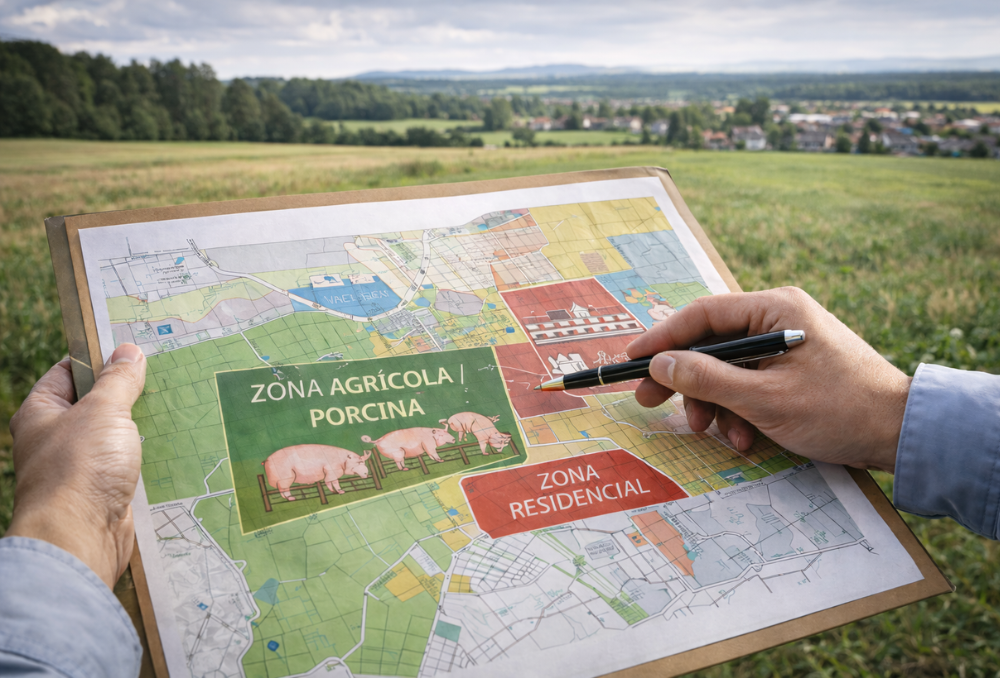
As environmental regulations have progressed, the land itself has also changed. In different parts of the country, residential development expanded into rural areas, bringing new housing developments closer to existing agricultural and industrial activities that had been operating in accordance with prevailing regulations.
When such growth happens without an integrated land-use plan, it can cause tensions that might not have arisen when the projects were approved. Case-by-case analysis does not obviate the need to define the productive orientation of specific territories in advance or to guide housing growth using clear criteria. A lack of planning heightens uncertainty and makes social coexistence more difficult.
Regulatory challenges in rural areas
Chile has yet to adopt a comprehensive framework law on land use planning that integrates urban and rural development in a coherent manner. Regulations are currently structured primarily around the definition of urban areas established by the General Law on Urban Planning and Construction. Land outside these areas is subject to regulations on the subdivision of rural properties from the 1980s.
Under these circumstances, the growth of rural subdivisions has been substantial. According to data from the Ministry of Housing and Urban Development, more than 279,000 subdivisions were approved in rural areas in 2021. This figure rose to more than 339,000 in 2022, which represents growth of over 21% in just one year. This sustained increase has taken place, in many cases, without comprehensive territorial planning to account for its long-term effects.
The result has been new residential areas springing up in areas originally meant for farming, often with limited infrastructure, which puts more pressure on productive land and water resources.
“When housing expands without planning, it not only strains coexistence with pre-existing productive activities, but also causes environmental and social impacts that end up affecting the communities themselves,” explains Daniela Álvarez.
Regulatory developments and ongoing debate
In light of this situation, important steps have been taken in recent years. Notice 475 (2022) issued by the Agricultural and Livestock Service (SAG) strengthened oversight in rural subdivisions that incorporated characteristics typical of housing developments, safeguarding the agricultural use of the land.
In addition, a bill amending the General Law on Urban Planning and Construction to regulate residential development in rural areas (Bulletin 17006-01) is currently in the first stage of constitutional review. The bill would raise the standards required for this type of development.
At the same time, Regional Land Use Plans (PROT) have the potential to establish location criteria, define areas of productive activity, and guide future growth. However, full implementation still faces administrative challenges, which leaves room for uncertainty precisely where planning is needed most.
International experiences
Experiences from other countries show that preventive land-use planning is key to balancing productive development and quality of life. A case in point is Denmark, whose model integrates land-use planning and environmental regulation under a coherent, long-term approach.
Danish land use planning—regulated by Planning Act No. 813 of 2007—protects agricultural land as a strategic land use, establishes differentiated zones, and creates buffer zones between productive and residential activities. This coordination has led to stable coexistence between communities and agriculture, along with high levels of regulatory certainty. It is no coincidence that the country has become a world leader in pig farming.
Experiences in Germany, Belgium, Australia, and Canada further support this logic: environmental regulation is closely linked to land use hierarchy, standards vary depending on the type of area, and in many cases, existing operations are protected from new residential developments.
In countries such as Australia, for example, the “agent of change” principle establishes that whoever introduces a new use in the territory must take the necessary mitigation measures, thereby ensuring that pre-existing productive activities can continue. This logic distributes responsibilities clearly and mitigates future conflicts.
In such models, existing authorizations provide stability for productive activities, preventing subsequent changes to the environment from creating incompatibilities without clear transition rules.
“What these experiences show is that legal certainty is not a privilege of the productive sector; it is a necessity for attracting investment, reducing conflict, and giving communities long-term stability,” emphasizes Daniela Álvarez.
Planning ahead to protect development
In Chile, the challenge is not to slow down growth, but to organize it. Moving toward a principle that protects legally established productive activities, defining areas of productive influence, and guiding housing development with clear territorial criteria are necessary steps to avoid future conflicts.
Likewise, incorporating factors such as noise and odors into land use planning—and not just environmental regulations—would help prevent conflicts and improve predictability.
Strengthening land use planning is not just a regulatory issue. It is a strategic decision to protect productive land, ensure stability for communities, and consolidate the long-term sustainable development of the pig sector and the Chilean agri-food system as a whole.