





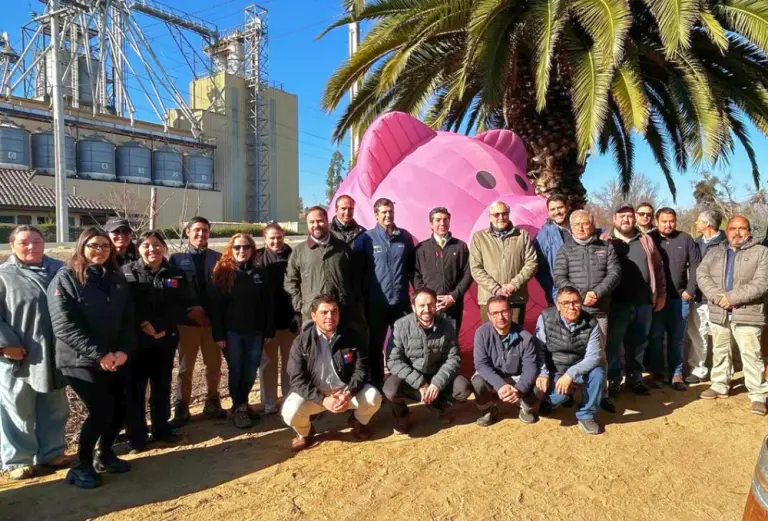
Representatives from the Provincial Presidential Delegation, along with officials from the Regional Ministerial Secretariats (SEREMI) of Agriculture, Energy, and the Environment, visited Agrícola AASA’s Campesino plant located in Melipilla to get a firsthand look at its processes and the company’s initiatives with regard to environmental stewardship, circular economy, and renewable energy generation.
The visit, held on June 23, was also attended by ChileCarne’s president, Juan Carlos Domínguez, who accompanied the delegation on a tour of the company’s facilities.
The tour included several facilities that showcase the company’s comprehensive approach to sustainability. These included the food processing plant, the slurry processing plant, the biodigester, and the biogas and power generation facility, where visitors learned about the process of waste recovery and renewable energy production. The visit also included a tour of the company’s natural wetland water treatment system, its fertigation areas, and its eco-park-initiatives designed to promote the efficient use of resources and strengthen the circular economy in swine farming.
Agrícola AASA has been a pig producer for more than 40 years. Founded in 1985, the company now has 8,200 breeding sows and a herd of nearly 130,000 pigs across five facilities located in the municipalities of Los Andes, Melipilla, and Nancagua.
One of the highlights of the visit was the waste recovery system developed by the company. Through AASA Energía, a company founded in 2017, the biogas generated at slurry treatment plants is used to generate electricity. The initiative has an installed capacity of 1 MW in Melipilla, which contributes to more efficient resource management and increasingly sustainable pig farming.
The visit gave the authorities an opportunity to observe concrete examples of innovation, efficiency, and circular economy practices implemented by the company, as well as the industry’s efforts to move toward increasingly sustainable production that is aligned with Chile’s environmental challenges.